
Week Links: 4/19/26


Great piece from JSTOR Daily on Chinese-Indonesian photography.
Some context:
The major obstacle to understanding the 1965–66 killings as a case of genocide, he explains, is the exclusion of “political groups” from protection under the 1948 Genocide Convention—the standard legal definition of genocide under international law. He proposes, however, that “in the slaughter of the Communists, the criterion of past affiliation had a finality and immutability quite comparable to massacre by virtue of race and it was based on a similar imposition of collective responsibility.” The killings, moreover, he explains, transcended the boundaries of inter-group conflict, by additionally drawing upon “class” and “religious” differences between victims and perpetrators. Likewise, ethnicity was also a factor, as evidenced by the killing of “Chinese merchants and their families.” He thus suggests that the military’s target group was substantially broader than a political group and contained elements of deep inter-generational identity.
Because Communists were the target of violence, as opposed to an ethnic group, has led also to controversy in the scholarly literature about whether to understand the mass killings as genocide. Coppel concluded in 1983 that “the total number of Chinese killed can scarcely have exceeded two thousand.” But Communists and “Chinese” ethnic identity were often conflated. If you have not seen the brilliant, troubling documentary The Act of Killing, check out the trailer below:
RIP Alexander Kluge. I have recently been reading work by him and his longtime collaborator, Oskar Negt. A fine write-up in The Baffler.
In the United States, the book by which he is probably best known, with the possible exception of Air Raid, is Public Sphere and Experience (Öffentlichkeit und Erfahrung). Written in 1972 in collaboration with the sociologist Oskar Negt and not translated into English until 1993 (Verso reissued it in 2016), Public Sphere and Experience was a response to Habermas’s Structural Transformation of the Public Sphere (1962, translated 1989). Against a backdrop of Frankfurt School pessimism about the so-called consciousness industry, which seemed to leave no place in society for active political dissent, Habermas had developed the concept of publicity or public-ness—in German, Öffentlichkeit, or openness—in an attempt to salvage the emergent institutions of the eighteenth century, where free discussion flourished outside both the government and the market. For Habermas, the bourgeois public sphere offered both a valued history and a still-viable norm. Kluge and Negt, arguing that the existing bourgeois public sphere had largely suppressed working-class experience, put forward the alternative concept of a subaltern counterpublic. They paid more attention to modern mass media, especially television, and (naturally enough) the student uprisings of the late 1960s, which had not yet happened when Habermas was writing. Unlike other critics of Habermas, however, who saw the concept of the public sphere as fatally compromised by its exclusion of non-normative gender, class, racial, and sexual experience, they retained Habermas’s key concept. For as Kluge put it, “The public sphere is the site where struggles are decided by other means than war.”
His remarkable film The Power of Emotion is available on Youtube.
The war against Iran sputters on, like a mower low on gas.
After the Ceasefire, LRB Blog:
‘The funniest part of this war,’ Mohsen said with a faint smile, ‘was when the US vice president suggested sending carrier pigeons to tell Iranians about the ceasefire.’
We laughed. Perhaps the first real laughter in weeks.
Amin, the café owner, said: ‘I was reminded of a Charlie Chaplin film – the one where the war is already over, but he doesn’t know it and keeps standing guard. Or that day Kuwait accidentally shot down two American planes. History is full of these absurd moments.’
It seems that the US has an oversupply of absurdity, a net exporter of the absurd. This morning, Trump Threatens Peace:
US President Trump says Iran has committed a “serious violation” of the ceasefire but a peace deal “will happen one way or another – the nice way or the hard way”.
If you are looking for something other than the Anglophone slant on this story, the Substack below collects and translates Lebanese reporting. Very useful.

Compare that coverage to today’s NYTimes front page:
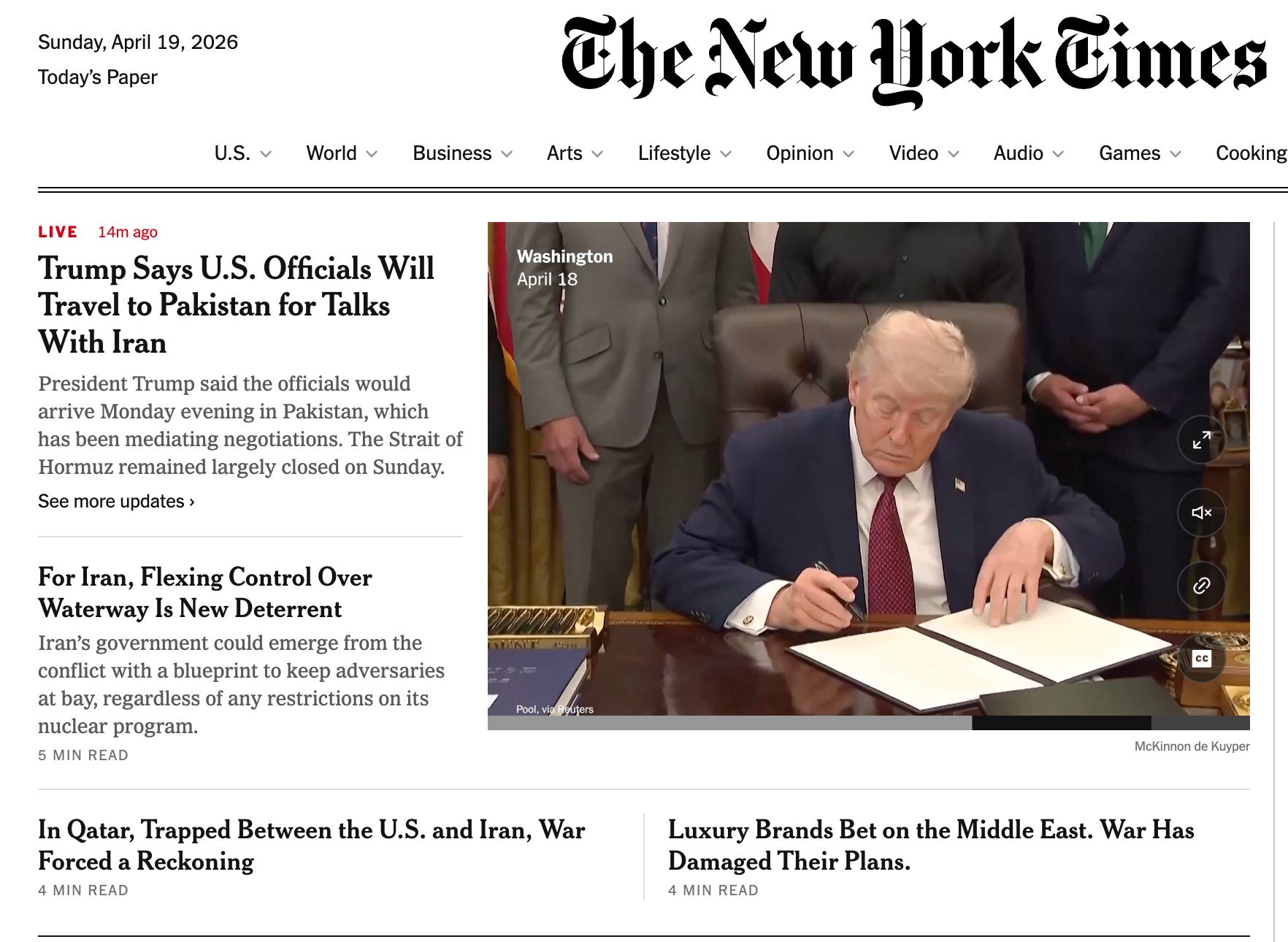
Qatar in the past tense — Lebanon simply absent.
The view from US military deployments is just as grim:
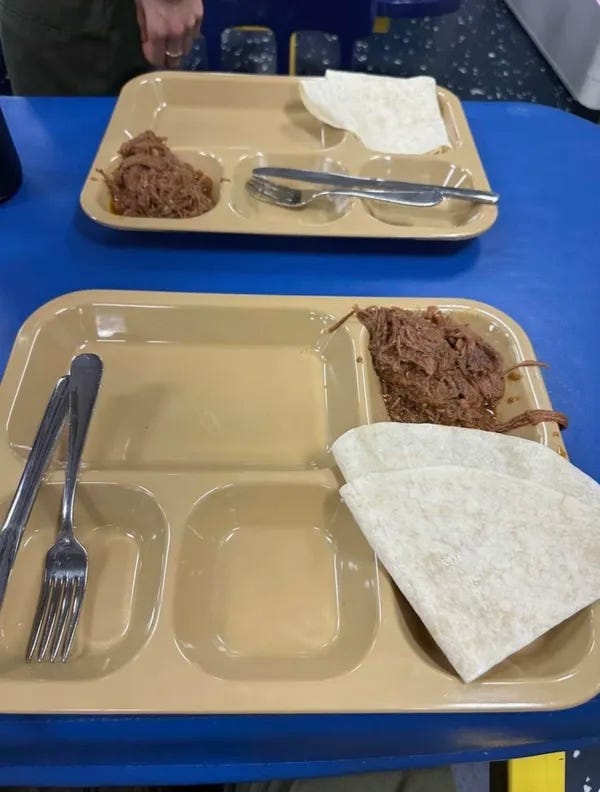
Dan F. was alarmed when his daughter, a Marine aboard the USS Tripoli, a warship deployed to fight the Iran war, sent him a photo of a meal served on the ship. A lunch tray, two-thirds empty, carried one small scoop of shredded meat and a single folded tortilla.
A picture of a mid-April dinner on the USS Abraham Lincoln, shared by a service member with his family, was similarly unappetizing – a small handful of boiled carrots, a dry meat patty and a gray slab of processed meat.
What will be our next space adventure?
The plan is to send a nuclear reactor into space. Last year, Trump issued a plan to install a nuclear reactor on the surface of the moon, but new orders describe a brand new vision. The April 14 plan lays out a mandate for NASA, the Pentagon and the Department of Energy to develop a nuclear system capable of orbiting the moon, and to have it launch-ready as soon as 2028.
To achieve this vision, NASA will partner with various agencies to fast-track mid-power fission reactor designs and surface power variants, which will compete to achieve near-term demonstration of viable models. “The White House’s overall strategy is to conduct parallel and mutually-reinforcing NASA and Department of War (DOW) design competitions to enable near-term demonstration and use of low- to mid-power space reactors in orbit and on the lunar surface, and prepare to deploy high-power reactors in the 2030s,” Interesting Engineering reported this week.
Although there’s little new here, Israeli Holocaust and genocide scholar Omer Bartov’s recent press tour for his book seems to indicate that bastions of liberal Zionist consensus like The New Yorker are no longer. Here’s the interview with David Remnick, who has to be given some credit for pushing the editorial line beyond most of his peers in so-called “legacy” media.
Rümeysa Öztürk, Tufts University grad arrested by ICE agents last year, returns to Turkey, Boston Globe
“I am choosing to return home as planned to continue my career as a woman scholar without losing more time to the state-imposed violence and hostility I have experienced in the United States — all for nothing more than co-signing an op-ed advocating for Palestinian rights,“ Öztürk said in a statement released Friday. “I invite everyone to recognize the privilege it is for any country to host international scholars, and the hole that is left in our society when that privilege is lost.”
Climate
The Man Whom Exxon Tried To Drill, Lever News
Mark van Baal is considered a pioneer of shareholder activism in the fossil fuel industry. But the Dutchman, now in his late fifties, with short gray curls and bushy black eyebrows, didn’t set out to be; he more or less fell into it. His story perhaps doubles as a lesson on why regular people can — and should — care about the strange, esoteric world of corporate proxy votes, SEC “no-action letters,” and annual general meetings.


Wildfires used to ‘go to sleep’ at night. Climate change is turning them into prime burning hours, Phys.org
Fires used to die down or even die out at night as temperatures dropped and humidity increased, but that’s happening less often. The number of hours in North America when the weather is favorable for wildfires is 36% higher than 50 years ago, according to a study Friday in Science Advances.
Places such as California have 550 more potential burning hours than the mid-1970s. Parts of southwestern New Mexico and central Arizona are seeing as much as 2,000 more hours a year when the weather is prone to burning fires, the highest increase seen in the study, which looked at Canada and the United States. The research looked at times when conditions were ripe for fire, but that didn’t mean fires occurred during all that time
AI Watch
Possibly the most famous living mathematician, Terence Tao, has chimed in with a philosophical reflection on AI and its relationship to mathematics:
Our piece took over a year to write – which means, at the current pace of development in the field, that some of it is already slightly out of date. Nevertheless, it was an instructive exercise for both of us to try to look beyond the immediate technical issues presented by current AI and formalization tools and try to point out the philosophical questions that we will have to grapple with as these tools become increasingly capable and integrated into our profession, using prior examples of technological advancement as a guide.
The paper itself is quite interesting. Though some of it is sort of a compilation of commonplace arguments, it also discusses the unique problems AI poses to mathematical research. Neither the “smell test” of intuition nor formalization of proofs will solve the practical and theoretical challenges of huge numbers of AI-generated mathematical papers. I also like their metaphor that AI is the “vanilla extract” of intellectual production.
Our suggested guidance for navigating this current transition is to make a culinary analogy: vanilla extract, a common ingredient in most sweet recipes famous for its nearly universally appealing scent. Ingested by itself, vanilla extract is usually considered extremely unpleasant, but its addition in small amounts is widely regarded as improving and enhancing the other flavors of the dish, even when it cannot be differentiated from them. While it is easy to conclude that more vanilla extract is better, most people who have used it understand there is some upper limit beyond which it ruins the dish entirely. Most of us do not have a clear sense of what that upper limit actually is, so find it wisest to keep it as a very minor addition.