Week Links: 5/10/26

Happy Mothers’ Day (US).

“There is No Hard Problem of Consciousness,” Noema:
Updating the understanding of a phenomenon is not to deny it. Sunsets were understood in Antiquity and the Middle Ages as the descent of the sun in its daily motion over the Earth. Today, we understand them as a result of the Earth’s rotation, which turns us toward its shady side, where the sun gradually becomes no longer visible. Such an update in understanding does not make sunsets illusory or unreal.
Similarly, our soul won’t become illusory or unreal if we get a better sense of how our brain functions. We can still call our soul our “soul,” even if we understand ourselves better. I call it so, because this notion — the soul — is dear to my soul.
Mamdani’s media team has a no-meme policy. HuffPo:
“Social-first formats like short-form video only work when they carry useful information,” she told HuffPost. “Strong political communicators answer the questions people actually have: What does this mean for me? Why should I care? What can I do next?”
To answer those questions in a way that’s compelling but not cringeworthy, Mamdani’s digital video team said, they maintain a strict “no meme policy.”
“You see other politicians trying to do that, and it never works, it always feels forced,” a spokesperson for the video team said. “We’re not doing this to go viral. We are trying to make stuff that is engaging, and if it goes viral, awesome.”
Javier Milei’s popularity plunges as corruption scandals shake his cabinet, Monocle:
The scandals are clearly irking Argentines, who voted for Milei in 2023 on the back of pledges to overhaul the political system. Now corruption ranks as a major public issue again, with polls showing it to be a major concern for 50.3 per cent of Argentines. Milei, meanwhile, appears to be foundering with an approval rating of 35.5 per cent. Despite a landslide victory in last year’s midterms, Milei is now at the weakest point of his term so far. What until recently looked like a safe re-election for Milei next year is now increasingly in doubt.
But corruption is not the only issue weighing on the minds of voters. Argentines appear to be tiring of the country’s lethargic economy. For years, Milei was given the benefit of the doubt as he implemented a programme of reforms and austerity, which succeeded in taming triple-digit inflation and bringing a semblance of stability to one of the world’s most fragile economies.
Thousands run Palestine Marathon under shadow of Israel’s war on Gaza, AJE.

I wish the analysis here had gone a little deeper, but worth a read:

In US higher ed, Canvas was hacked, Cornell’s president runs over students after a debate, and the Yale Report on trust in higher ed raises hackles. Llano on the Canvas debacle:

To understand Orbán’s defeat, one needs to reflect on the visible and underground opposition streams as they manifested themselves in investigative journalism, academic institutions, civil society activism, cultural projects, and political contestation over the last decade and a half. These streams put up a resistance that, in the long run, contributed to the erosion of the regime’s legitimacy. There are, in fact, marked similarities between this moment and the collapse of communism in Hungary in the 1980s, as both “late Orbánism” and “late Kádárism” lost their capacity to control the circulation of information, becoming increasingly illegitimate in the eyes of their citizens, even though they still retained a hard core of true believers and cynical fellow travelers.
And The Economist copes with Reform election result in the UK:
Results in Wales show that Reform’s path to power is far from assured. In the country that Mr Farage once called his main priority, Plaid Cymru, a nationalist party, consolidated the centre-left vote and won 43 seats to Reform’s 34. “Stopping Reform UK” was the second most commonly cited reason for supporting Plaid, after a belief that the party is “standing up for Wales”. If centre-left voters across Britain can similarly be persuaded to co-ordinate to stop Reform, Mr Farage’s current support would be insufficient to form a government—a dash of hope for Labour on a bleak day.
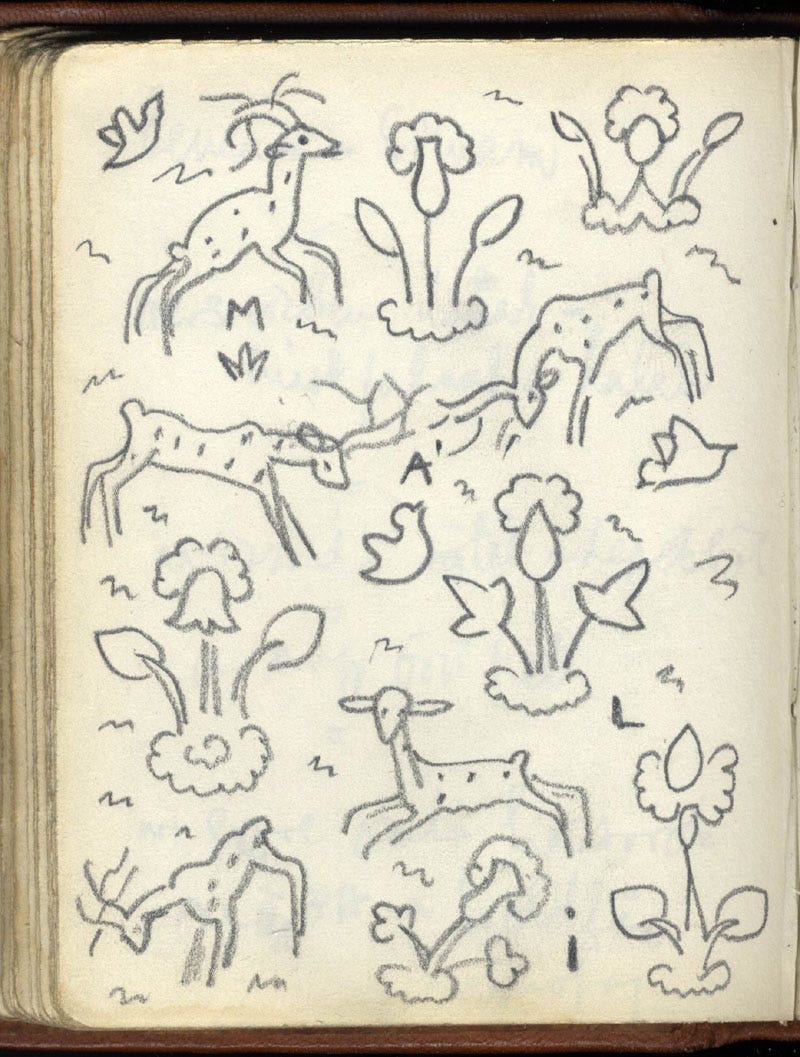
Drawing from Miklós Radnóti’s notebook — its remarkable story can be read here.