
Week Links: 5/31/26

I promise a return to normal blog post schedule this month. A number of (good) life-changing events have stacked up. But now I am returning to my writing schedule.
This morning my wife and I watched the astounding film Black Orpheus. I now count it alongside The Color of Pomegranates as one of the most gorgeous films I’ve seen.
Relatedly, Lula launches a free-of-charge streaming service for Brazilians showing Brazilian film. A model for a reinvention of public media?
And in case you missed the Note, I also wrote about a film. Read it here:


Some new attention to old psychoanalysis. One of the names listed here, Patricia Gherovici, is a personal acquaintance. I have never met a more generous thinker or person. I’ve also recommended Jacqueline Rose’s work to a number of psych-suspicious friends and colleagues. And earlier this week, in one of those lovely kinds of casual conversations that is the most serious kind life can offer—between friends thinking together differently—I introduced Lacan’s concept of the “four discourses.” “I can’t believe I care about Lacan,” she said. Here’s one of Steve Llano’s takes on it — you will find it illuminating, I promise:
News
I’m not normally one to recommend calling your elected representatives to other fellow US Citizens, but if you are opposed to US militarism and the Gaza genocide, this is one you should pick up the phone on. From Responsible Statecraft:
Buried in the House’s version of the 2027 National Defense Authorization Act (NDAA) released on Tuesday, is section 224, entitled “United States-Israel Defense Technology Cooperation Initiative.” The provision would arguably do more to intertwine the U.S. military with the Israeli military than the more than $200 billion (inflation adjusted) in military assistance Israel has received from the U.S. since its founding in 1948.
Section 224 lays the groundwork for bilateral research and development, co-production of weapons, joint ventures, licensing agreements, and seemingly every manner of U.S.-Israeli military-industrial complex cooperation. The U.S. and Israel already work together heavily on missile defense, but this provision would greatly expand coordination to seemingly every area of defense tech, including AI, quantum, autonomous systems, directed energy, cyber, biotech, and many more. It also proposes “network integration” and “data fusion.” In other words, the U.S. military’s data could soon be the Israeli military’s data.
Wars are always worse than you know. Recent evidence from the Iraq War. Photos revealed from the Haditha massacre. Reported at The New Yorker.
Another consideration of yesterday’s violence and its repercussions. On Uvalde, and the response to the failures of policing being more policing, from The Intercept:
This failure to save lives was not, as I wrote at the time, a failure of police work. It in fact exemplified what police critics and abolitionists have stressed for decades, with reams of evidence. Police do not save lives or prevent crime. Policing is not the “thin blue line” between social peace and chaotic violence. And the work of policing is a far cry from the heroic myth so stubbornly lodged in the American imagination. This was not, of course, the lesson learned by Texas authorities after the shooting. Instead, the state’s response was as predictable as it was doomed to produce only more violence in Texas schools: They added more cops. There were no well-researched, pragmatic policy changes around limiting assault rifles, regulating the hyper-destructive expanding bullets that ripped children’s bodies apart, and increasing mental health support — things that could actually stop shootings like in Uvalde, which was carried out by a troubled 18-year-old. Texas school districts instead poured billions of dollars into stationing police at every public school campus in the state. The results, as a New York Times report published this week found, has been an horrific spate of violent police abuse against children in schools across the state.
AI Watch
As I frequently tell my debate students, one of the capacities you must develop to be able to competently participate in public argumentation is an understanding of commonly used examples. The article below explores the history of one commonly made by economists (though, as noted, also commonly misused by them): that the ATM did not replace the bank teller.
But we also need to be able to supply our own examples should we wish to develop or extend a point in public discourse. One that may be relevant to the “discussion” over AI regulation. In 1807, the US Federal Government abolished the slave trade. In 1820, slavers could be tried with a capital offense. Obviously, whatever moral righteousness may have inspired this legislation did not end slavery.
AI refusal requires understanding, not just refusal:
Seventy-five percent of professional artists say they want to block AI crawlers from using their work, but research suggests that even on platforms where those options are available, only a fraction actually do. Why? Because while many opt-out tools exist – including robots.txt, NoAI meta tags, the TDM Reservation Protocol, and platform-specific directives like Google-Extended – they are not easily accessible, and subsequently adoption is negligible.
Believe it or not, a book called The Future of Truth may contain a lot of AI-generated statements.
From Mason & Dixon by Thomas Pynchon:
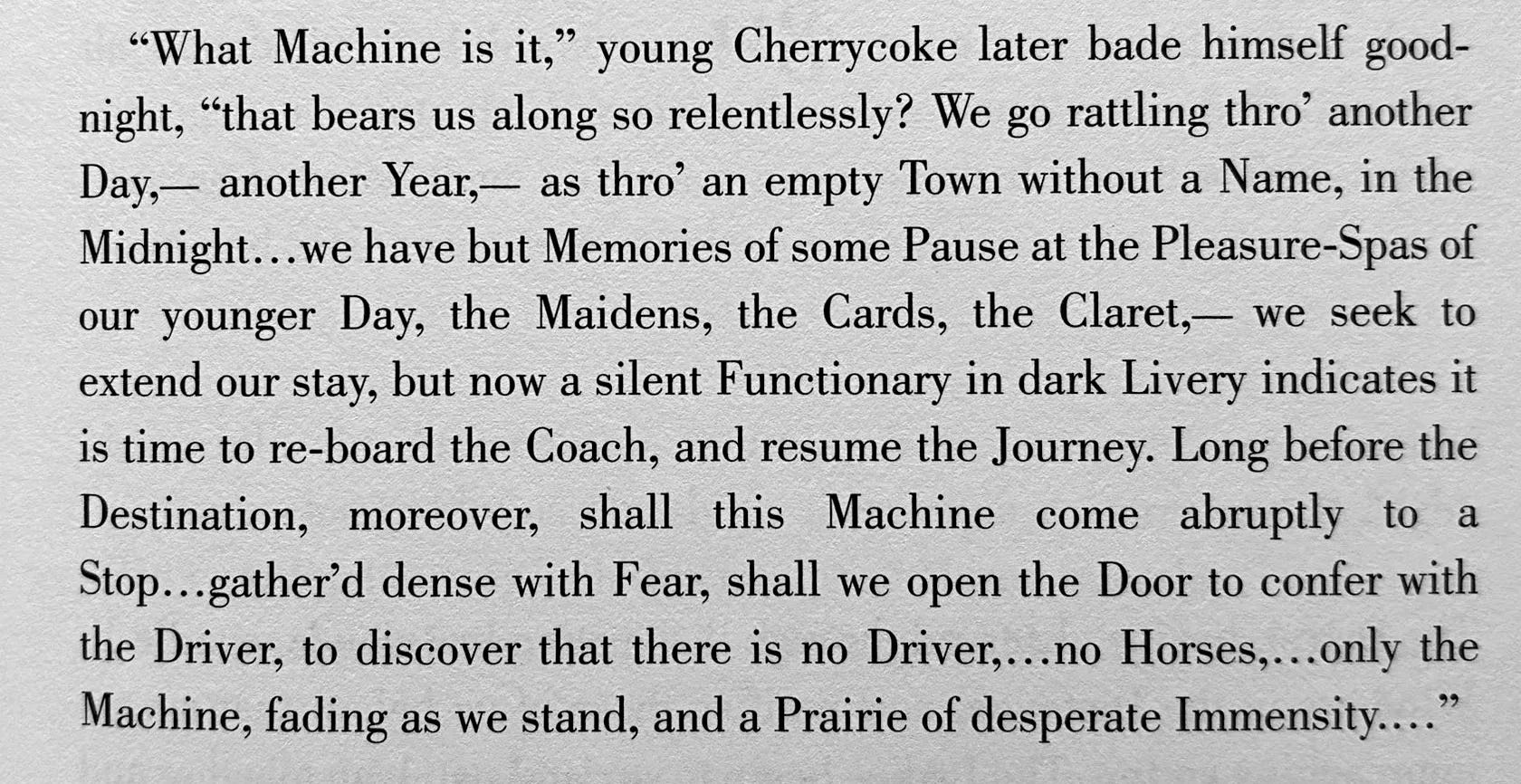
Just something neat:
Re: David Oks piece:
Richard Susskind's book "How to Think About AI" talks about this as automation v. innovation v. elimination, where automation is 1:1 replacement of the human, slotting in like Oks talks about bere. Innovation is doing the job (or addressing a problem, as Susskind says) in a different way--Susskind uses the ATM as an example. Elimination is new tech eliminating the problem altogether, like how cars eliminated the need for dealing with horse poop from carriages. Susskind's point is that everyone assumes that how they do their job is, more or less, how it must be done and that they are far too focused on the automation of jobs, when that is by and large unlikely. Innovation, which changes the nature of the job, and elimination, which gets rid of the need for the job, are much more likely as a tech is diffused through society but also much more difficult to prepare for.
Side note: I liked Susskind's book as a resource for teaching. It has a lot of categories / frameworks like this for classifying AI and its impacts and risks, which can be useful for asking students to think about stuff.